
A Blast from the Past - a fresh look at Ecclesiam Suam 50 years on
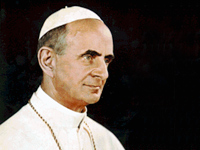 I was surprised to discover that 50 years ago this month (August 1964), Pope Paul VI wrote his first encyclical, Ecclesiam Suam. So as it was its golden anniversary, I decided to glance over the document. I found the writing style dated – sexist and imperial. But equally an urgency and anxiety about the fierce challenges confronting the world and the church pervades this message from a "brother". (ES, 119)
The humanity of the man predominates as he sets out set out principles that he wants to characterise his pontificate. As for the world; there have been incredible developments in the past 50 years but there is a dreadful familiarity too. I listen to the news about disease in Africa, deaths in Syria, Iraq, and Gaza and the possibility of the conflict in Ukraine leading to another Cold War. So what did the Pope say 50 years ago and what difference does it make for us here and now?
The Church as Physician
The concern of Paul VI is pastoral rather doctrinal. He is conscious that the Second Vatican Council will deal with the latter. After reading the document, the image of the doctor remains in my mind. Sadly we have the examples of Dr. Sheik Umar Khan of Sierra Leone and Dr. Ameyo Stella Adadevoh of Nigeria. This man and this woman are eminent doctors who are among those who have died while caring for people who had the very infectious and deadly disease, Ebola. It is the sense of urgency in the encyclical that reminds me of the sacrifice of these people, and others, who were courageous in taking on the task of service for life. Paul VI urges us to protect ourselves and others from what is deadly, but not to turn away in fear or indifference to any challenge and in particular from those in need. Indeed it is the Spirit of God that compels us to undertake the mission in the name of the gospel to love God and our neighbour. (ES, 63) This encyclical is his first message as Pope. And so I understand that in order to prepare for such an urgent task, Paul VI describes three principle policies that he wants to characterise his work and the work of the whole Church.
Self-Awareness, Renewal and Dialogue.
So first we, as Church or as a Christian community, are called to be courageous enough to recognise that we never attain our ideal image. (ES, 10) Recognising that in reality we tend to fall short of our ideals lead us to the second principle of renewal. (ES, 41) Renewal is described as "metanoia" (ES, 51) which is the faithful conversion of a disciple. So by facing reality and being true to our vocation as Christians and as Church, we move on to the third principle, dialogue (ES, 64). The process does not end there. Looking ahead, Paul VI said, "In fact the work which is beginning today will never come to an end. This is a law of our earthly, time-bound pilgrimage." (ES, 117)
Ground Rules
So when a parish declares its mission is to welcome our neighbour, can we be confident that we are well prepared? When a neighbour challenges us on complex issues, what characterises a Christian response today? In seeking to be faithful witnesses to the gospel, we are reminded that "truth is wedded to charity and understanding to love." (ES, 82) This summary of the encyclical (ES, 72-77) may help to clarify ground rules for any group who want to be involved in dialogue:
• Dialogue is the initiative of the Church, as we proceed "without waiting to be summoned by others".
• Dialogue must be sincere, without limits and not motivated by self-interest.
• It is not coercive but uses friendliness, persuasion and ordinary conversation.
• It is respectful.
• It is offered to everyone.
• It may be a slow process but "We should not however on that account postpone until tomorrow what we can accomplish today..."
• Dialogue is characterised by clear communication that is readily grasped.
• It is patient under contradiction and inclines towards generosity.
• It is confident; "not only in the power of one's own words, but also in the good will of both parties to a dialogue" and so excludes all self-seeking.
• And finally the speaker is always at pains to learn the sensitivities of his audience. (ES, 81)
Conclusion
So having reviewed what the Pope Paul VI said 50 years ago, I was surprised how relevant it is. In fact it is very much to the point; for debates in our society, for conflicts that have been mentioned above and for dealing with issues within the Church too. At a very practical level, I would use it as a resource for preparing ground rules for the Embracing Inclusion programme which is an initiative of the Parish of the Travelling People to reflect on hospitality at parish level in order to bridge the gap between the Traveller community and other parishioners. Finally, this anniversary has reminded me of the importance of the work of dialogue and the mission of the Church. Therefore, I am grateful for finding this encyclical 50 years on, and grateful too for those who are facing all kinds of challenges today; some mundane perhaps and others truly vital.
(Reflections on Ecclesiam Suam by Colin Thomson)